
Fair Value Gaps, usually shortened to FVGs, have become one of the most widely discussed concepts in modern price-action trading. They appear across Forex, XAUUSD, indices, cryptocurrency, futures and individual stocks.
The useful part is not simply identifying a three-candle gap. The real value is understanding what caused price to move aggressively enough to create it, where liquidity was located, whether market structure changed, and whether the market has a reason to return to that area.
What Is a Fair Value Gap?
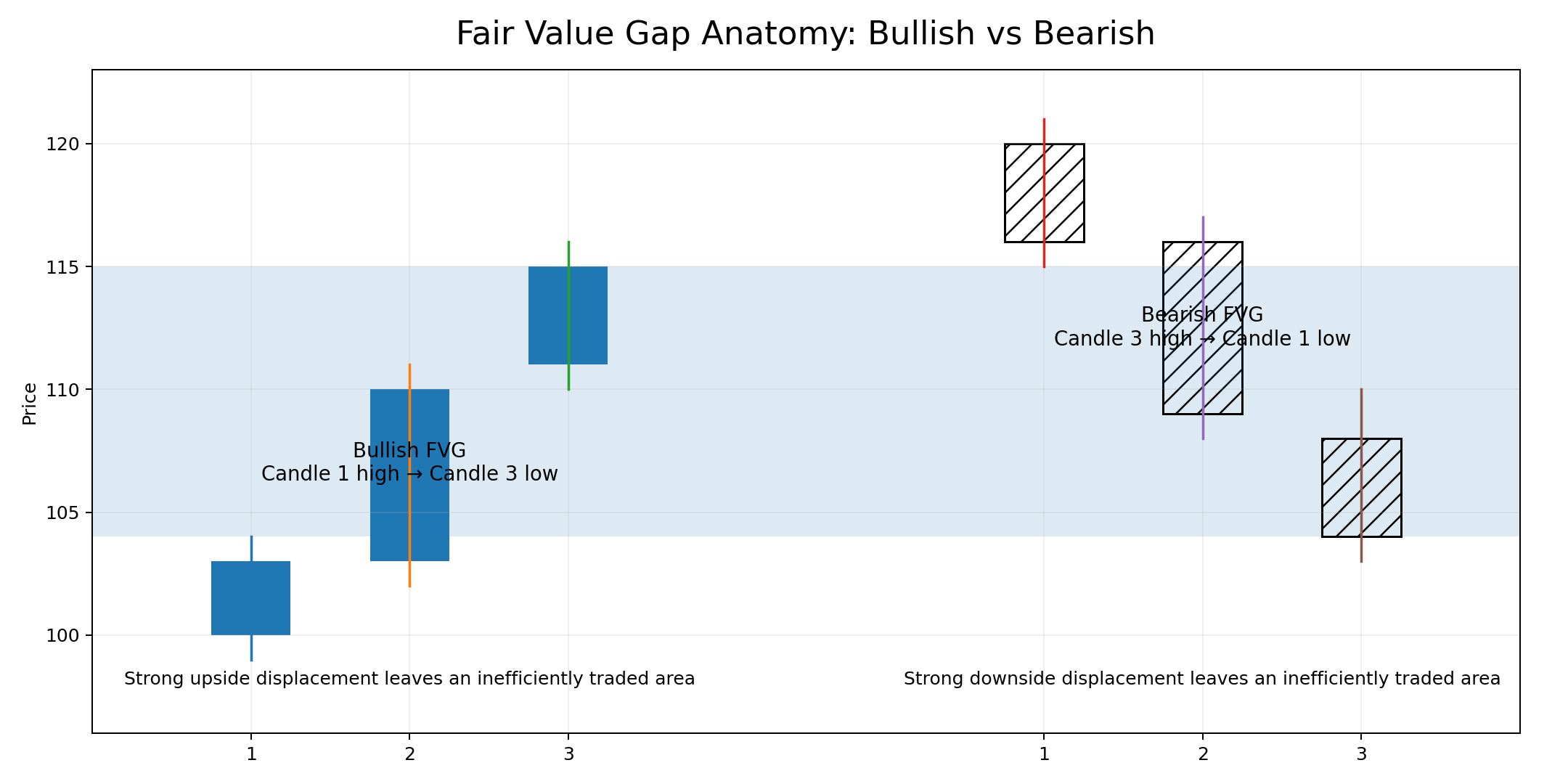
A Fair Value Gap is typically identified using a three-candle sequence. The middle candle is usually the displacement candle: the candle that moves strongly enough to create an area of limited overlap between Candle 1 and Candle 3.
Bullish FVG
A bullish FVG exists when the low of Candle 3 remains above the high of Candle 1. The area between those two prices is considered the imbalance.
Bearish FVG
A bearish FVG exists when the high of Candle 3 remains below the low of Candle 1. The area between those prices becomes the bearish imbalance.
What Actually Causes a Fair Value Gap?
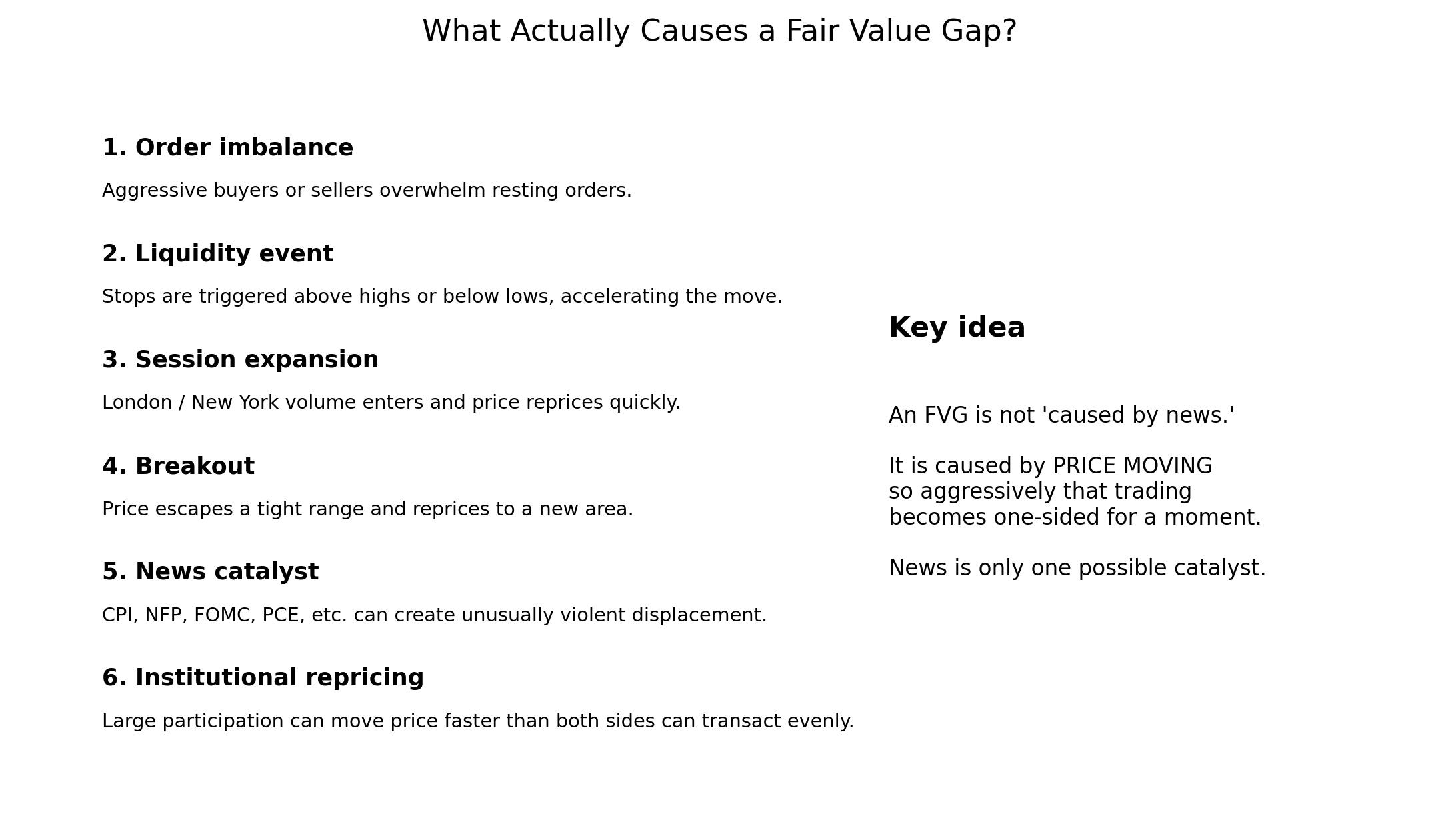
Markets function through an ongoing auction between buyers and sellers. Under normal conditions, both sides transact through nearby price levels relatively smoothly. But sometimes one side becomes far more aggressive than the other.
If buyers aggressively consume available sell orders, price must move higher to find additional sellers. If sellers aggressively hit available bids, price must move lower to find more buyers. When that repricing happens fast enough, the chart can leave behind the structure traders identify as an FVG.
1. Aggressive Buying or Selling Pressure
The simplest explanation is aggressive order flow. A wave of buyers may begin lifting available offers so quickly that the market reprices upward before balanced two-sided trading can develop. That creates bullish displacement.
The opposite happens during aggressive selling. Sellers may hit available bids rapidly, forcing price downward in search of more buyers. This creates bearish displacement.
This is why an FVG can form on a completely normal trading day with no major economic announcement.
2. Liquidity Sweeps
Liquidity sweeps are one of the most important conditions to understand when using Fair Value Gaps. Previous highs and lows often attract orders.
Above an obvious previous high, for example, there may be stop losses from short sellers, breakout buy orders, algorithmic orders and pending entries. If price trades above that high, those orders can trigger.
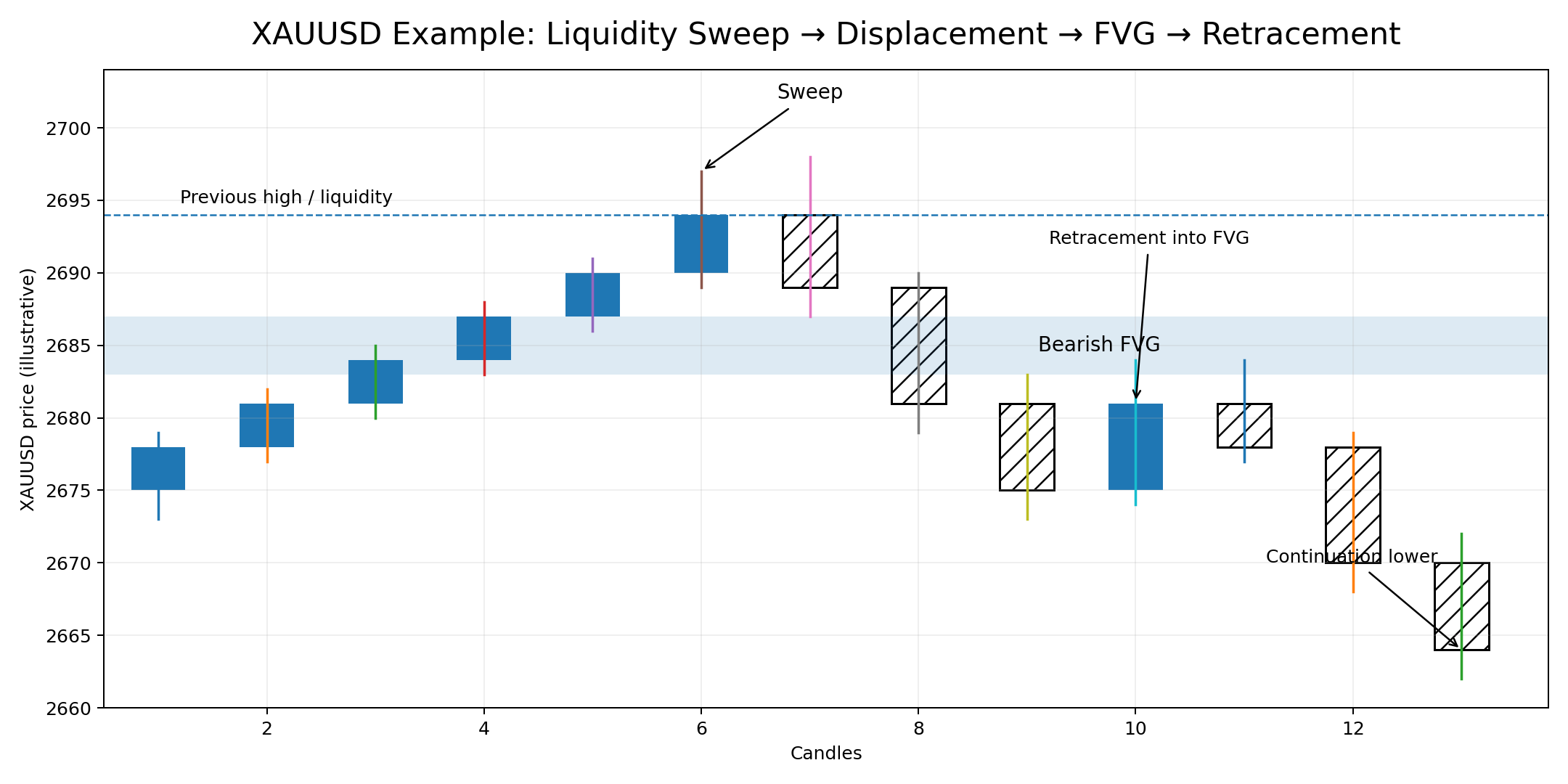
But if the breakout fails and aggressive sellers immediately enter, price can reverse sharply and create bearish displacement. That displacement may leave a bearish FVG behind.
Liquidity Sweep →
Rejection →
Displacement →
FVG →
Retracement
The same logic works in reverse below a previous low. Price may sweep downside liquidity, reject the lower prices, displace upward and leave a bullish FVG behind.
3. London and New York Session Expansion
Forex and XAUUSD frequently move more aggressively when major financial centres become active. During quieter periods, price may consolidate inside a relatively narrow range.
As London or New York participation increases, more institutional orders, hedging activity, algorithmic flows and speculative orders can enter the market. That can produce range breakouts, liquidity sweeps, trend acceleration and clean Fair Value Gaps even when there is no major scheduled news release.
4. Breakouts From Consolidation
A market can spend hours balancing inside a narrow range. When that balance finally breaks, several types of orders can hit at once: breakout entries, stop losses, momentum orders and algorithmic activity.
The result may be a fast directional expansion that leaves an FVG behind. In that case, the Fair Value Gap is evidence that price repriced rapidly away from the previous area of balance.
5. Economic News
Major economic releases can absolutely create some of the largest and most obvious Fair Value Gaps.
For XAUUSD, events such as U.S. CPI, Nonfarm Payrolls, PCE inflation, Federal Reserve decisions, FOMC press conferences and unexpected geopolitical developments can cause rapid repricing.
Markets may suddenly change expectations regarding interest rates, Treasury yields, the U.S. dollar or risk sentiment. Algorithms and discretionary traders can react almost simultaneously, producing aggressive candles and visible imbalances.
6. Stop-Loss Cascades
Stop losses themselves can help accelerate price.
If a market breaks below an obvious low, stops from long positions may begin executing as sell orders. Those sales push price lower, which can trigger additional stops. This chain reaction can create strong displacement and a bearish FVG.
The same process can happen above a previous high when stops from short positions begin executing as buy orders.
7. Institutional Repricing
Large participants sometimes need to execute orders that are much larger than typical retail positions. If available liquidity near the current price is insufficient, the market must move to find counterparties.
This can contribute to sharp repricing and the formation of an FVG.
It is generally more useful to think of an FVG as evidence of aggressive one-sided participation than to assume that one particular institution deliberately created the exact gap visible on the chart.
Does an FVG Mean Nobody Traded There?
No. This is an important distinction.
A Fair Value Gap does not necessarily mean absolutely zero transactions occurred inside the area. Unlike a traditional overnight stock-market gap, the market may have traded through those prices.
Not: “No trading happened here at all.”
Why Does Price Sometimes Return to an FVG?
Price often revisits an imbalance, but there is no rule saying every Fair Value Gap must be filled.
A return can happen for several reasons:
- Profit taking: traders who entered early begin locking in gains.
- Mean reversion: price retraces after an aggressive expansion.
- Remaining orders: market interest may still exist around the origin of the move.
- Liquidity search: price may move back toward an area containing additional orders.
- Normal market structure: trends usually move through expansion and pullback rather than in a straight line.
This is why a strong trend can leave several FVGs behind without immediately returning to every one of them.
Fair Value Gap + Liquidity Sweep: A Stronger Setup
The FVG becomes far more useful when it is connected to a broader price-action story.
Consider a bearish XAUUSD setup. Gold trades toward an obvious previous high. Price breaks above that high, triggering stops and breakout orders. The breakout then fails. Sellers enter aggressively, price drops, market structure weakens and a bearish FVG is created.
Instead of chasing the initial drop, a trader can wait for price to retrace toward the imbalance and then evaluate whether sellers respond again.
Fair Value Gap + Rejection Zone
Another useful combination occurs when an FVG overlaps a rejection zone, previous support or resistance, a session high or low, or another important market-structure level.
For example, if gold repeatedly fails near resistance and then creates a bearish FVG after a strong rejection, the setup contains more information than an isolated FVG sitting in the middle of random price action.
The rejection zone tells you sellers defended the area. The displacement shows that sellers gained control. The FVG then identifies the area left behind by that aggressive move.
FVGs in Strong Trends
Fair Value Gaps are not only reversal tools. They can also be used for continuation setups.
In a strong uptrend, bullish expansion may leave a bullish FVG. Rather than chasing price at the top of the move, a trader may wait for a pullback into the imbalance and then look for evidence that buyers are returning.
The same principle works in a downtrend with bearish FVGs.
FVGs Inside Consolidation
This is where many traders get into trouble.
Sideways markets can generate plenty of technically valid FVGs, but price may simply fill one gap, reverse, create another gap, fill that one and continue chopping inside the same range.
An FVG inside heavy consolidation generally deserves less weight than one created after a meaningful liquidity event and strong displacement.
High-Quality FVG vs Weak FVG
Higher-Quality FVG
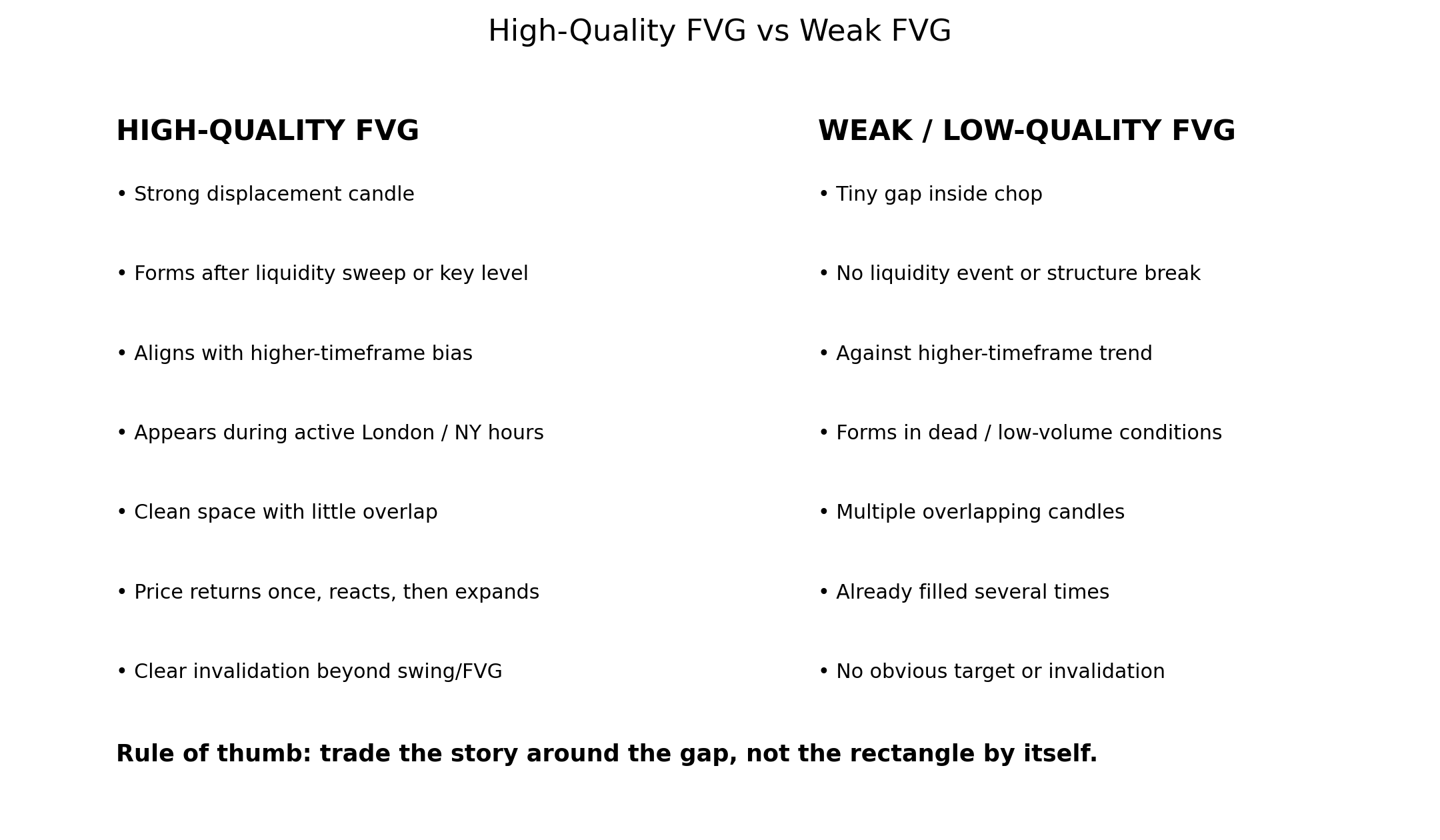
- Strong displacement candle
- Forms after a liquidity sweep or at a key level
- Aligns with higher-timeframe structure
- Appears during active market hours
- Has clean separation and limited overlap
- Has a logical invalidation level
- Has a clear liquidity target
Weaker FVG
- Tiny gap inside choppy price action
- No liquidity event
- No meaningful displacement
- Against dominant higher-timeframe structure
- Already tested repeatedly
- Forms during dead market conditions
- No obvious target or invalidation point
When Is the Best Time to Trade FVGs?
There is no single universal time because every market has different active periods. For Forex and XAUUSD, traders generally pay the most attention to periods when institutional participation and liquidity increase.
London Session
London often produces range expansion, liquidity sweeps and directional movement across major Forex pairs and gold.
New York Session
New York is especially important for XAUUSD because gold is sensitive to U.S. economic releases, interest-rate expectations, Treasury yields, the U.S. dollar and institutional participation.
London / New York Overlap
When both sessions are active, liquidity and volatility can increase substantially. This can create excellent displacement, but it also means conditions can move quickly.
What Timeframe Should You Use?
FVGs appear on virtually every timeframe, from one-minute charts to daily charts. Lower timeframes naturally produce more gaps and more noise.
One practical multi-timeframe workflow is:
- 4-hour: identify major directional bias and key structure.
- 1-hour: mark meaningful liquidity, highs, lows and major zones.
- 15-minute: identify displacement and cleaner FVGs.
- 5-minute: refine the entry if your strategy requires more precision.
Should You Enter at the Edge, Middle or End of the FVG?
There is no single correct answer. Some traders enter when price first touches the FVG. Others use the midpoint of the gap. More conservative traders wait for price to trade into the FVG and then require additional confirmation.
Possible confirmation can include:
- rejection wick
- engulfing candle
- lower-timeframe liquidity sweep
- market structure shift
- momentum returning in the expected direction
Where Should the Stop Loss Go?
A stop loss should represent the point where the trade thesis is invalidated. Depending on the setup, that might be beyond the recent swing, beyond the liquidity sweep, behind the rejection zone, or outside the full FVG.
The stop should not simply be placed at an arbitrary distance because the trader wants a larger risk-to-reward ratio.
Where Should the Target Be?
Common targets include previous highs or lows, equal highs or lows, session extremes, opposing liquidity, major support and resistance, another FVG, or a predefined risk-to-reward objective.
A good setup should ideally answer both questions before entry:
and
Where is price reasonably trying to go?
Do Fair Value Gaps Always Get Filled?
No.
Some FVGs fill almost immediately. Some are only partially mitigated. Some react near the midpoint. Others remain untouched for days or weeks while price continues trending away.
An old FVG is therefore not a reason by itself to trade against a strong trend.
FVG vs Traditional Market Gap
A traditional stock-market gap may occur when a stock closes at one price and then opens the following session substantially higher or lower, leaving an actual discontinuity between sessions.
A Fair Value Gap is different. It generally describes an imbalance within a three-candle price sequence created by rapid movement.
Forex and XAUUSD trade almost continuously during the trading week, so traditional session gaps are less common than in individual stocks. FVGs, however, appear constantly.
Why FVGs Are So Common in XAUUSD
Gold is particularly interesting for FVG traders because it frequently experiences strong directional expansion.
XAUUSD can react aggressively to:
- Federal Reserve policy
- U.S. interest-rate expectations
- Treasury yields
- U.S. dollar movement
- inflation data
- employment data
- geopolitical risk
- central-bank demand
- institutional flows
This creates plenty of displacement and therefore plenty of FVGs. But it also creates plenty of weak FVGs that should be ignored.
A Practical FVG Trading Checklist
- Determine higher-timeframe direction. What are the 1H and 4H charts doing?
- Identify liquidity. Mark meaningful highs, lows, equal highs/lows and session extremes.
- Watch for a sweep. Did price take liquidity before reversing or accelerating?
- Demand displacement. Did the market actually move aggressively?
- Check structure. Did the move break a meaningful swing or confirm direction?
- Locate the FVG. Is it sitting at a useful technical location?
- Check freshness. Has price already traded through the FVG multiple times?
- Check market conditions. Is this an active liquid period or random chop?
- Define invalidation. Where is the trade clearly wrong?
- Define the target. Where is the next meaningful liquidity or structure objective?
The Biggest Mistake Traders Make With Fair Value Gaps
The biggest mistake is turning the rectangle itself into the entire strategy.
A trader learns to identify FVGs and suddenly every chart becomes covered with boxes. Every box becomes a potential trade.
That misses the point.
The FVG is evidence that something happened. Your job is to understand why the market displaced, what liquidity was involved, whether structure changed, and where price may be trying to move next.
Final Takeaway
A Fair Value Gap is created when aggressive order flow causes price to move quickly enough that the market leaves behind an area with limited overlapping price action.
The catalyst may be aggressive buying or selling, a liquidity sweep, stop-loss cascade, session expansion, breakout, institutional repricing, trend acceleration or economic news.
News can create FVGs, but news is not what defines them. Displacement does.
The stronger way to use the concept is not:
“There is an FVG, so I should trade it.”
It is:
“Why did this move happen, what liquidity was taken, where is the market trying to go, and does this FVG give me a logical place to participate?”
Educational content only. Trading leveraged products involves substantial risk and is not suitable for every investor.