
Canada is a major energy and commodity exporter, maintains extensive trading relationships with the United States, operates an independent monetary policy and has a currency that responds to both domestic economic developments and international financial conditions.
For forex traders, understanding these relationships is particularly important when analyzing USD/CAD.
The Canadian dollar can strengthen when commodity prices rise, when Canadian interest-rate expectations increase or when global investors become more willing to hold Canadian assets.
But these relationships are not permanent.
Oil can rise while CAD falls.
The Bank of Canada can raise interest rates while the Canadian dollar weakens.
Canadian employment can exceed expectations while USD/CAD moves higher.
These outcomes may appear contradictory to traders who rely on simple economic assumptions.
They become easier to understand when the Canadian dollar is analyzed within a broader macroeconomic framework.
Understanding the Canadian Dollar
The Canadian dollar, commonly identified by its international currency code CAD, is Canada’s national currency.
In foreign exchange markets, it is frequently referred to as the loonie, a nickname derived from the loon depicted on Canada’s one-dollar coin.
CAD is actively traded against several major currencies, including:
- U.S. dollar — USD/CAD;
- euro — EUR/CAD;
- British pound — GBP/CAD;
- Japanese yen — CAD/JPY;
- Australian dollar — AUD/CAD;
- Swiss franc — CAD/CHF.
Each currency pair represents a different economic relationship.
USD/CAD measures the Canadian dollar against the U.S. dollar.
EUR/CAD introduces the relative economic and monetary-policy outlook for the euro area.
CAD/JPY can be influenced by Canadian economic conditions, Japanese monetary policy, interest-rate differentials and global market sentiment.
This distinction is important because a currency can appreciate against one currency while depreciating against another.
For example, CAD might strengthen against USD while weakening against EUR.
There is no contradiction.
The Canadian dollar is being measured against two different currencies with different economic conditions.
How USD/CAD Works
USD/CAD expresses the number of Canadian dollars required to purchase one U.S. dollar.
Suppose USD/CAD is trading at:
1.3800.
That means one U.S. dollar is worth approximately 1.38 Canadian dollars at the quoted exchange rate.
When USD/CAD Rises
If USD/CAD moves from 1.3800 to 1.4000, more Canadian dollars are required to purchase one U.S. dollar.
The U.S. dollar has appreciated relative to CAD.
Equivalently, the Canadian dollar has depreciated relative to USD.
When USD/CAD Falls
If USD/CAD moves from 1.3800 to 1.3600, fewer Canadian dollars are required to purchase one U.S. dollar.
CAD has strengthened relative to USD.
Canada’s Floating Exchange Rate
Canada operates a floating exchange-rate system.
Under this system, the Canadian dollar’s exchange rate is determined primarily by supply and demand in foreign exchange markets rather than by a fixed exchange-rate target.
The Bank of Canada does not attempt to maintain USD/CAD at a predetermined level.
Instead, the central bank conducts monetary policy primarily to achieve its inflation objective.
The Bank of Canada explains that allowing the currency to float helps the Canadian economy adjust to changing international economic conditions.
For example, if foreign demand for Canadian exports declines, a weaker Canadian dollar may improve the competitiveness of some Canadian products in international markets.
Conversely, a stronger currency can reduce the Canadian-dollar cost of some imported goods.
The exchange rate therefore acts as an important adjustment mechanism within the Canadian economy.
Official source: Bank of Canada — Understanding Exchange Rates.
1. Interest Rates and Monetary Policy
Interest-rate expectations are among the most important variables influencing USD/CAD.
However, it is not sufficient to look at the Bank of Canada’s policy rate in isolation.
Forex traders need to compare Canadian monetary policy with U.S. monetary policy.
The Bank of Canada
The Bank of Canada sets its target for the overnight interest rate as its principal monetary-policy instrument.
Changes in the policy rate influence borrowing costs, financial conditions, economic activity and inflation.
These changes can also affect demand for Canadian-dollar-denominated financial assets.
The Federal Reserve
The Federal Reserve conducts monetary policy in the United States.
Its decisions influence U.S. interest rates, Treasury yields, financial conditions and the attractiveness of U.S.-dollar-denominated assets.
USD/CAD therefore responds to changes in the relative monetary-policy outlook between the two countries.
Understanding Interest-Rate Differentials
Suppose U.S. interest rates are expected to remain higher than Canadian interest rates.
All else equal, higher expected returns on some U.S.-dollar-denominated assets can increase their relative attractiveness.
That can support USD against CAD.
Now suppose Canadian interest-rate expectations increase relative to U.S. expectations.
The relative return advantage of U.S. assets may narrow.
That can provide support for the Canadian dollar.
However, currency markets do not respond mechanically to interest-rate differentials.
Investors also consider expected exchange-rate movements, inflation, credit risk, economic uncertainty and the broader investment environment.
Why Expectations Matter More Than the Announcement Alone
If the Bank of Canada raises rates by 0.25 percentage points and markets had fully anticipated the decision, the immediate exchange-rate reaction may be limited. An unexpected change in the central bank’s future policy guidance may have a larger effect than the rate decision itself.
What the Bank of Canada’s Research Shows
The Bank of Canada has examined how interest-rate differences, commodity prices and changes in perceived economic risk contribute to fluctuations in the Canadian dollar.
Its research emphasizes that changes in interest-rate expectations can affect exchange rates, but cannot explain all currency movements on their own.
Economic uncertainty and changes in the risk premium investors demand for holding a currency can also be important.
Research: Monetary Policy, Interest Rates and the Canadian Dollar.
2. Why Oil Prices Matter for the Canadian Dollar
The Canadian dollar is frequently described as a commodity-linked currency.
One reason is Canada’s substantial natural-resource sector.
Canada produces and exports oil, natural gas, metals, agricultural products and other commodities.
Energy exports are particularly important to Canada’s external trade and several provincial economies.
The Traditional Oil–CAD Relationship
When oil prices rise, Canadian energy producers may receive greater revenue for the commodities they export.
Higher energy revenues can improve Canada’s terms of trade, support corporate income and increase economic activity in energy-producing regions.
Under certain conditions, these developments can support demand for CAD.
That is why traders often observe:
Oil prices rising → CAD strengthening → USD/CAD declining.
But this is a conditional relationship, not a universal trading rule.
What Are Terms of Trade?
Terms of trade compare the prices a country receives for its exports with the prices it pays for its imports.
When the prices of Canadian exports increase relative to Canadian import prices, Canada’s terms of trade improve.
Higher commodity prices can therefore support Canada’s external purchasing power.
The Bank of Canada has identified commodity prices and relative interest rates as important long-term influences on the Canadian dollar.
Official source: Flexible Exchange Rates, Commodity Prices and Price Stability.
3. Why Oil and the Canadian Dollar Sometimes Move in Opposite Directions
One of the biggest mistakes in USD/CAD fundamental analysis is assuming that higher oil prices must produce a stronger Canadian dollar.
Consider two different scenarios.
Scenario A: Oil Rises Because Global Demand Improves
Suppose global manufacturing activity strengthens, industrial production increases and energy demand rises.
Oil prices may increase alongside improving economic expectations.
In this environment, Canadian energy exporters can benefit from stronger demand and higher prices.
The Canadian dollar may receive support from improving commodity revenues and global growth expectations.
Scenario B: Oil Rises Because Global Supply Is Disrupted
Now suppose oil prices increase because a geopolitical conflict disrupts energy production or transportation.
Higher energy prices may create inflationary pressure while simultaneously weakening global economic activity.
Financial markets may begin pricing:
- higher U.S. inflation;
- tighter Federal Reserve policy;
- higher U.S. Treasury yields;
- slower global growth;
- and increased demand for U.S. dollar liquidity.
Under these conditions, the U.S. dollar can strengthen even while oil prices rise.
USD/CAD may therefore increase despite the apparent positive effect of higher oil prices on Canadian energy revenues.
4. Canada’s Trade Relationship With the United States
Canada and the United States maintain extensive economic and financial relationships.
Trade in goods and services, cross-border investment, business activity and integrated supply chains create ongoing demand for both currencies.
Major sectors include:
- energy;
- automotive manufacturing;
- machinery;
- agriculture;
- forestry products;
- metals and minerals;
- and business services.
Because of this close relationship, changes in U.S. economic conditions can influence the Canadian economy directly.
Strong U.S. Demand Can Support Canadian Exports
When U.S. consumers and businesses increase spending, demand for some Canadian exports may rise.
That can support Canadian production, business revenues and employment.
However, the exchange-rate effect also depends on what is happening to the U.S. dollar itself.
Strong U.S. economic data may simultaneously increase expectations for higher U.S. interest rates.
As a result, USD/CAD can appreciate even when stronger U.S. demand is positive for Canadian exporters.
Trade Restrictions and Economic Uncertainty
Tariffs and other trade restrictions can change the relative attractiveness of investment in Canada and the United States.
For example, uncertainty over access to the U.S. market may affect:
- Canadian export volumes;
- corporate investment decisions;
- manufacturing activity;
- employment;
- inflation;
- and future monetary-policy expectations.
The Bank of Canada has specifically examined how trade-policy uncertainty can influence the Canadian-dollar exchange rate beyond the effects of interest-rate differentials alone.
Official research: Recent Factors Affecting the Canada–US Exchange Rate.
5. Inflation and the Canadian Dollar
Inflation measures changes in the general price level of goods and services.
Canada’s Consumer Price Index is published by Statistics Canada and provides an important measure of consumer-price inflation.
The Bank of Canada uses inflation information when assessing whether monetary policy is appropriately calibrated to its price-stability objective.
Why Higher Inflation Can Support CAD
If Canadian inflation exceeds expectations, investors may anticipate that the Bank of Canada will maintain higher interest rates or tighten monetary policy.
All else equal, this can increase the relative attractiveness of some Canadian-dollar-denominated assets.
CAD may strengthen.
Why Higher Inflation Can Also Weaken CAD
Higher inflation is not automatically positive for a currency.
If inflation rises while economic growth deteriorates, markets may become concerned about:
- weaker real household purchasing power;
- reduced economic growth;
- higher business costs;
- and declining real investment returns.
Currency markets may also focus more heavily on U.S. inflation and Federal Reserve policy than on the Canadian report.
The relevant question is how new information changes the expected economic and monetary-policy outlook of both countries.
Headline Inflation vs Underlying Inflation
Traders should distinguish between headline CPI and measures designed to identify more persistent inflationary pressure.
For example, an increase in gasoline prices can temporarily lift headline inflation.
But policymakers may interpret that development differently from a broad increase in prices across many categories.
Understanding the composition of inflation helps traders interpret the central bank’s likely reaction.
6. Canadian Employment and Economic Growth
Canadian employment data can generate significant movement in USD/CAD.
Statistics Canada’s Labour Force Survey provides information about:
- employment changes;
- unemployment;
- labour-force participation;
- employment by industry;
- and wage developments.
These figures help financial markets evaluate the condition of Canada’s labour market.
Why Employment Matters
Stronger employment can support household incomes and consumer spending.
It may also affect the Bank of Canada’s assessment of economic capacity and inflationary pressure.
Weaker employment may suggest that economic activity is slowing.
However, traders should avoid treating the headline employment number as a complete assessment of the labour market.
Look Beyond the Headline
Suppose Canada reports an increase in employment.
Before interpreting that result as unambiguously positive, examine:
- full-time versus part-time employment;
- the unemployment rate;
- labour-force participation;
- wage growth;
- revisions to previous reports;
- and how the result compares with market expectations.
An employment increase accompanied by a rising unemployment rate can provide a more complicated economic signal than the headline figure alone suggests.
Canadian and U.S. Employment Released Together
Canadian and U.S. employment reports can occasionally be scheduled for the same morning.
For USD/CAD, the relative strength of the two reports may matter more than either report in isolation.
For example, stronger-than-expected Canadian employment may support CAD, while an even larger positive surprise in U.S. employment may support USD more strongly.
USD/CAD can therefore rise despite a positive Canadian employment report.
7. Global Demand for the U.S. Dollar
The U.S. dollar occupies a central role in international financial markets.
It is widely used in:
- international trade;
- foreign exchange transactions;
- global financing;
- reserve management;
- and cross-border investment.
According to the Bank for International Settlements’ 2025 Triennial Survey, the U.S. dollar was on one side of approximately 89% of global foreign exchange transactions during the survey period.
Source: BIS — Global Foreign Exchange Turnover Survey.
This widespread international use means USD/CAD can be affected by developments that have little direct connection to Canada’s domestic economy.
Example: A Global Financial Shock
Suppose an international financial disruption increases demand for U.S. dollar liquidity.
Investors, financial institutions and corporations may increase their demand for dollars to meet financing and liquidity requirements.
USD can appreciate against multiple currencies simultaneously.
Under those circumstances, the Canadian dollar may weaken against USD even if there has been no significant deterioration in Canadian economic data.
8. Global Market Risk Sentiment
Financial markets often distinguish between periods of greater willingness to accept risk and periods of heightened demand for liquidity and defensive assets.
These conditions are commonly described as:
Risk-on and risk-off environments.
Risk-On Conditions
During periods of improving global growth expectations, investors may become more willing to hold equities, corporate credit and other assets exposed to economic growth.
Under some circumstances, these conditions can support commodity-linked currencies such as CAD.
Risk-Off Conditions
During periods of financial stress, investors may reduce exposure to risk-sensitive assets and increase their demand for liquid U.S.-dollar-denominated assets.
USD/CAD may rise as a result.
However, the relationship between market sentiment and currencies is not fixed.
The source of the economic shock, interest-rate expectations and country-specific developments all affect the outcome.
9. Canadian and U.S. Bond Yields
Government bond yields are important indicators of financial-market expectations.
Forex traders frequently monitor:
- Canadian two-year government bond yields;
- U.S. two-year Treasury yields;
- Canadian ten-year government bond yields;
- U.S. ten-year Treasury yields.
Why Two-Year Yields Matter
Shorter-term government bond yields can be particularly sensitive to expectations about central-bank policy over the coming years.
If U.S. two-year yields rise relative to Canadian two-year yields, markets may be pricing a change in the relative monetary-policy outlook.
That can influence USD/CAD.
Why Ten-Year Yields Matter
Longer-term yields reflect a broader combination of expected interest rates, inflation expectations, term premiums and other financial factors.
They can help traders evaluate whether a currency movement is occurring alongside a wider repricing of economic and financial conditions.
Bond yields should not be treated as an automatic currency trading signal.
They are one component of a broader macroeconomic assessment.
10. Economic Indicators Canadian Forex Traders Should Monitor
A structured USD/CAD trading plan should include both Canadian and U.S. economic releases.
Different reports provide information about different parts of the economy.
| Economic Indicator | What It Measures | Why USD/CAD Traders Watch It |
|---|---|---|
| Bank of Canada Decision | Canadian monetary policy | Changes in Canadian rate expectations |
| Federal Reserve Decision | U.S. monetary policy | Changes in U.S. rate expectations |
| Canadian CPI | Consumer-price inflation | Inflation pressure and BoC expectations |
| U.S. CPI / PCE | U.S. consumer-price developments | Inflation pressure and Fed expectations |
| Canadian Labour Force Survey | Employment, unemployment and participation | Canadian economic and labour-market conditions |
| U.S. Employment Report | U.S. employment and unemployment | U.S. growth and monetary-policy expectations |
| GDP | Economic output | Relative economic performance |
| Trade Data | Exports, imports and trade balance | External demand and trade developments |
Use Primary Economic Sources
For Canadian data, traders can consult:
For U.S. data:
U.S. Bureau of Labor Statistics
U.S. Bureau of Economic Analysis
11. Why USD/CAD Sometimes Moves Opposite to the Economic News
One of the most important concepts in fundamental trading is the distinction between an economic result and the market’s expectations for that result.
Suppose analysts expect Canadian inflation to increase by 3.0%.
The actual report shows:
2.8%.
Inflation is still elevated, but the result is lower than expected.
Markets may interpret the report as reducing the likelihood of additional monetary-policy tightening.
CAD could weaken even though inflation remains positive and relatively high.
The Surprise Matters
Markets continuously incorporate expectations about future economic developments into asset prices.
When the actual result differs materially from expectations, prices may adjust rapidly.
However, traders should also examine:
- revisions to previous data;
- the underlying components of the report;
- changes in central-bank expectations;
- the initial reaction in bond yields;
- and broader U.S. dollar movement.
An economic release is not a simple instruction to buy or sell a currency.
It provides new information that market participants must interpret.
12. Combining Canadian Dollar Fundamentals With Technical Analysis
Fundamental analysis and technical analysis answer different questions.
Fundamental analysis helps identify economic developments that may influence the relative value of currencies.
Technical analysis helps identify the price structure through which those developments are being reflected in the market.
For USD/CAD, I prefer to use both.
Start With the Fundamental Context
Before analyzing the chart, I want to understand:
- the current Bank of Canada policy outlook;
- the current Federal Reserve policy outlook;
- relative Canadian and U.S. economic performance;
- important upcoming economic releases;
- oil-market developments;
- and whether the U.S. dollar is moving broadly against other major currencies.
Move to Higher-Timeframe Structure
On the daily and four-hour charts, I identify:
- the broader market direction;
- major swing highs and lows;
- important support and resistance;
- psychological price levels;
- trendlines and channels;
- and significant areas of prior price reaction.
The goal is to understand where price is positioned within the broader structure.
Use Lower Timeframes for Execution
Once price reaches an area of interest, I can move to the one-hour, 15-minute or other relevant execution timeframe.
There, I look for evidence that the market is responding to the level.
A bullish economic thesis does not justify buying at any price.
Likewise, a bearish economic thesis does not automatically make every rally a selling opportunity.
The technical structure should support the proposed trade and provide a logical invalidation point.
For a detailed explanation of this process, read our guide to top-down forex analysis and multi-timeframe trading.
USD/CAD: Technical Structure and Economic Fundamentals
The illustration below summarizes how USD/CAD price structure can be considered alongside oil prices, interest-rate expectations, Canadian economic data and global market sentiment. The chart and price levels are illustrative, not live quotations or a personal trade setup.
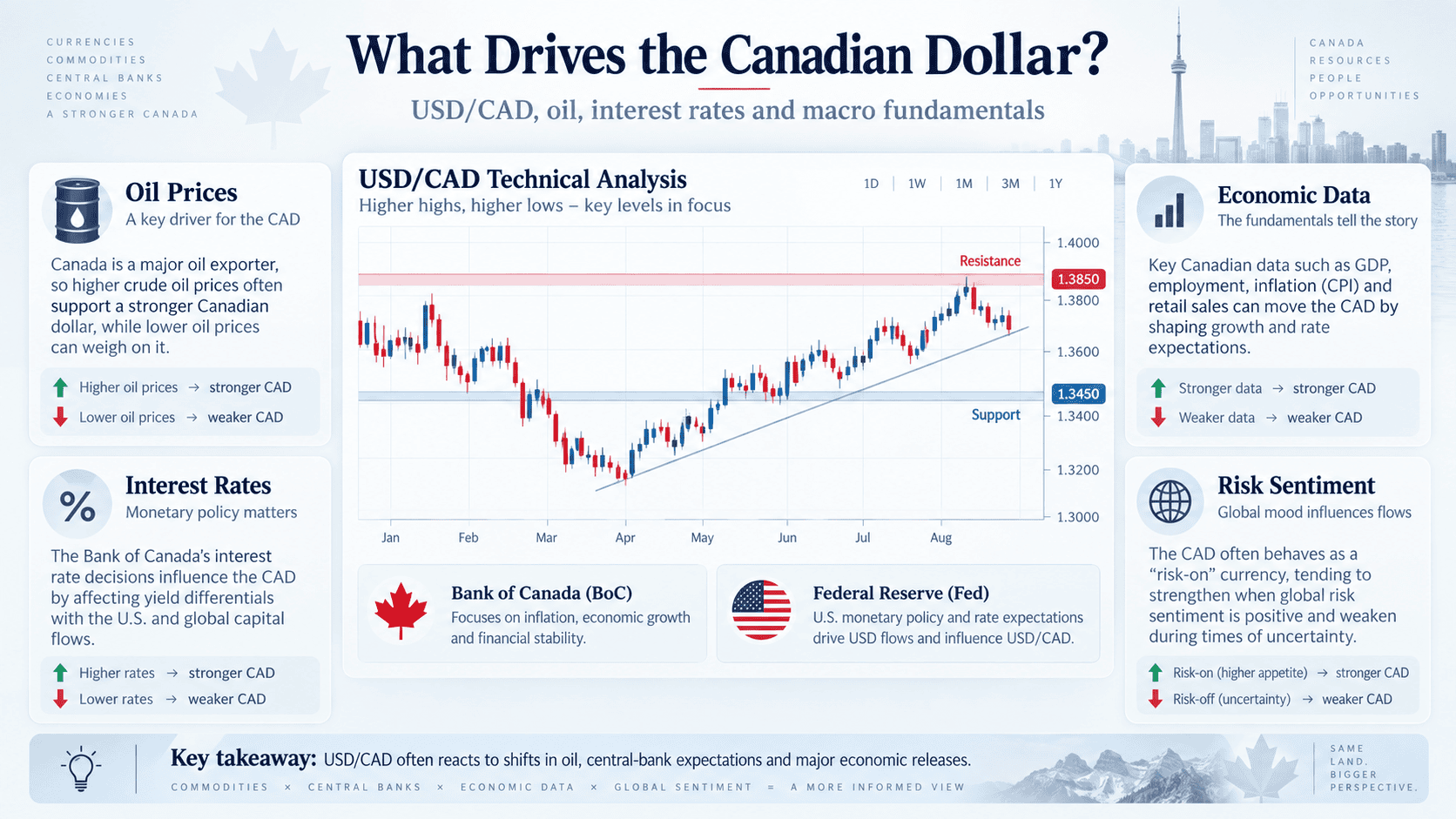
Technical levels can organize areas for further analysis, while economic fundamentals help explain why exchange rates may move. Neither approach predicts an exact future exchange rate.
13. A Practical USD/CAD Fundamental Trading Framework
A structured research process helps prevent traders from reacting impulsively to individual headlines.
For USD/CAD, I would organize the analysis into five stages.
Stage 1 — Establish the Monetary-Policy Context
- Review the latest Bank of Canada decision.
- Review the latest Federal Reserve decision.
- Compare the expected future path of Canadian and U.S. interest rates.
- Monitor changes in relevant government bond yields.
Stage 2 — Evaluate Economic Conditions
- Review Canadian and U.S. inflation data.
- Compare labour-market developments.
- Monitor economic growth and business activity.
- Identify major upcoming economic releases.
Stage 3 — Analyze External Drivers
- Review oil-market developments.
- Identify major trade-policy developments.
- Assess the broader strength or weakness of USD.
- Consider global market risk sentiment.
Stage 4 — Establish Technical Areas of Interest
- Review the daily and four-hour charts.
- Mark important support and resistance.
- Identify psychological price levels.
- Evaluate the current trend and market structure.
- Set price alerts around relevant areas.
Stage 5 — Evaluate Execution and Risk
- Wait for price confirmation appropriate to the strategy.
- Define the level that invalidates the trade.
- Calculate the position size.
- Review correlated exposure.
- Account for economic announcements and execution conditions.
- Decide whether the available opportunity justifies the risk.
14. Risk Management When Trading USD/CAD
Understanding Canadian economic fundamentals does not eliminate trading risk.
Currency markets can react unpredictably when several economic developments occur simultaneously.
For example, a Canadian inflation report may support CAD while a stronger-than-expected U.S. employment report supports USD.
Trade-policy announcements, geopolitical events or changes in oil prices may introduce additional volatility.
Before entering a USD/CAD position, traders should establish:
- the maximum loss permitted on the trade;
- the technical invalidation level;
- the appropriate position size;
- maximum total open risk;
- exposure to other USD and CAD positions;
- and the treatment of scheduled economic events.
Correlation and Portfolio Exposure
Suppose a trader is long EUR/USD and long USD/CAD simultaneously.
The EUR/USD long position creates short USD exposure.
The USD/CAD long position creates long USD exposure.
These positions may partially offset exposure to broad U.S. dollar movements.
However, they do not create a perfect hedge.
If EUR weakens against USD while CAD strengthens against USD, both positions can lose simultaneously.
The correct assessment requires examining the size of each position, the currency exposures involved and the potential combined loss.
For additional guidance, read our guide to position sizing and risk per trade.
Practicing Fundamental and Technical Analysis
Traders who are developing a USD/CAD strategy can use a demo account to practice combining economic information with technical execution.
A structured practice process might include:
- reviewing economic releases before each session;
- identifying the main Canadian and U.S. economic drivers;
- marking important USD/CAD technical levels;
- recording the market’s reaction to new data;
- testing position sizing;
- and reviewing actual versus expected trade outcomes.
A demo account cannot fully replicate the execution conditions or psychological pressure of live trading.
It can nevertheless provide a useful environment for learning the trading platform and testing a repeatable research process.
Open a Demo or Live Trading Account
Interested in practicing USD/CAD analysis on MetaTrader 5? Explore OX Securities’ demo-account offering and evaluate the platform before deciding whether opening or funding a live account is appropriate for you.
Frequently Asked Questions
What is the main factor driving the Canadian dollar?
There is no single factor that determines the Canadian dollar’s value. Interest-rate expectations, commodity prices, economic performance, trade developments, global financial conditions and demand for U.S. dollars can all influence USD/CAD.
Does the Canadian dollar rise when oil prices increase?
Higher oil prices can support CAD by improving Canada’s commodity-export revenues and terms of trade. However, changes in U.S. interest rates, global economic conditions and demand for USD can offset that effect.
Why does USD/CAD fall when CAD strengthens?
USD/CAD measures how many Canadian dollars are required to buy one U.S. dollar. When CAD strengthens relative to USD, fewer Canadian dollars are required, so the USD/CAD exchange rate declines.
Does a Bank of Canada rate hike automatically strengthen CAD?
No. Currency markets respond to expectations as well as actual decisions. If the rate increase was already anticipated or future policy guidance is less restrictive than expected, CAD may not strengthen.
Why does Canadian employment affect USD/CAD?
Employment data provides information about economic activity, household incomes and labour-market conditions. These developments can influence expectations for Bank of Canada monetary policy and the relative attractiveness of Canadian-dollar-denominated assets.
Can USD/CAD rise when the Canadian economy is performing well?
Yes. USD/CAD reflects relative currency value. The U.S. economy or U.S. dollar may strengthen more than CAD even when Canadian economic conditions are improving.
What U.S. economic indicators should Canadian forex traders monitor?
Important indicators include Federal Reserve decisions, CPI, PCE inflation, employment, GDP, retail sales and changes in U.S. Treasury yields.
Why do oil prices and USD/CAD sometimes rise together?
Oil may rise because of an inflationary supply disruption that simultaneously increases U.S. interest-rate expectations or global demand for USD. These forces can outweigh the traditional positive relationship between oil prices and CAD.
Should I use fundamental or technical analysis for USD/CAD?
The approaches address different aspects of the trading decision. Fundamental analysis can help explain the broader economic environment, while technical analysis can help identify price structure, potential trade locations and invalidation levels.
Is USD/CAD suitable for Canadian forex traders?
USD/CAD is particularly relevant to Canadians because the pair directly reflects the relative value of their domestic currency against USD. However, suitability for an individual trader depends on their strategy, experience, risk tolerance, financial circumstances and the products offered by their broker.
Final Perspective: Understanding the Canadian Dollar
The Canadian dollar does not move according to one simple economic formula.
Its value reflects a changing combination of:
- Canadian monetary policy;
- U.S. monetary policy;
- relative interest-rate expectations;
- commodity prices;
- international trade;
- domestic economic performance;
- global financial conditions;
- and demand for U.S. dollars.
For traders analyzing USD/CAD, the important skill is understanding how these variables interact.
Higher oil prices may strengthen CAD under one set of circumstances and fail to provide support under another.
Stronger Canadian employment may support CAD, but a simultaneous improvement in U.S. economic data can alter the relative currency response.
A Bank of Canada policy decision may move the exchange rate because it changes expectations about future interest rates rather than because of the actual decision alone.
That is why I prefer to begin with the broader economic picture before moving into the technical chart.
I want to understand the important macroeconomic drivers, identify where price is trading within the higher-timeframe structure and determine whether the market is providing a technically coherent opportunity.
Only then does execution become relevant.
Fundamentals provide context. Technical analysis provides structure. Risk management determines whether the opportunity is worth taking.
Continue exploring our Canada, Toronto Forex, Insights, Education and Risk Management sections for additional research.
Affiliate Disclosure: TorontoForex.com may receive compensation from qualifying referrals through the OX Securities partner registration link. This commercial relationship does not guarantee account approval, trading performance, profitability, regulatory eligibility or suitability. Readers should independently verify the applicable broker entity, legal terms and account conditions before opening or funding an account.
Editorial & Risk Disclaimer: This article is provided for general educational and market-research purposes only and does not constitute individualized investment, financial, legal or trading advice. Currency markets are influenced by multiple interacting variables, and economic relationships can change over time. No economic indicator, technical pattern or analytical framework guarantees a trading result. Forex and CFD trading involve substantial risk, including the potential loss of trading capital. Historical relationships and hypothetical scenarios should not be interpreted as reliable predictions of future exchange-rate movements.