
Toronto Forex Trading: The Complete Guide for Toronto Traders in 2026
Toronto forex trading places local traders in one of the most convenient time zones in the world for participating in the global foreign exchange market. Toronto operates alongside the New York financial session, while the Toronto morning also overlaps with London—one of the world’s most important financial centres.
For traders based in Toronto and throughout Ontario, this means major Canadian and U.S. economic announcements, institutional trading activity, central-bank decisions and some of the most liquid hours of the global forex market occur during normal daytime hours.
That geographic advantage is useful. It does not, however, make forex trading easy.
Foreign exchange is a leveraged financial market. Prices can move rapidly, economic announcements can change expectations in seconds, and poor risk management can turn an otherwise reasonable trading idea into a substantial loss.
This complete Toronto forex trading guide explains how the currency market works from a Toronto and Canadian perspective. We will cover market hours, USD/CAD, Canadian regulation, trading platforms, technical and fundamental analysis, position sizing, taxes, proprietary trading firms, common mistakes and the different ways traders can learn forex trading in Toronto.
What Is Forex Trading?
Forex is short for foreign exchange. It is the global marketplace where currencies are exchanged and their relative values are continuously determined.
Unlike purchasing shares of a single company, a forex transaction involves two currencies quoted against one another.
Some of the most widely followed currency pairs include:
- EUR/USD — euro versus the U.S. dollar
- GBP/USD — British pound versus the U.S. dollar
- USD/JPY — U.S. dollar versus the Japanese yen
- USD/CAD — U.S. dollar versus the Canadian dollar
- AUD/USD — Australian dollar versus the U.S. dollar
If a trader buys EUR/USD, the trader is effectively taking the view that the euro may strengthen relative to the U.S. dollar.
If the trader sells EUR/USD, the trader is expressing the opposite view.
The value of currencies can react to many economic and financial forces, including:
- interest rates
- inflation
- employment
- economic growth
- central-bank policy
- government policy
- geopolitical developments
- international capital flows
- commodity prices
- changes in global risk sentiment
This is one reason forex trading involves significantly more than identifying a chart pattern and clicking buy or sell.
Currency markets reflect constantly changing expectations about economies, monetary policy and the future relative value of currencies.
If you are still building your foundation, our Forex Education section contains additional lessons covering trading concepts, technical analysis and market behaviour.
Why Toronto Is Well Positioned for Forex Trading
Toronto is Canada’s largest financial centre and operates in the Eastern Time Zone, putting local traders directly inside the North American financial day.
The global forex market is commonly discussed in terms of four major trading sessions:
Sydney
Sydney helps begin the global forex trading week and represents the first major session in the commonly used 24-hour session model.
Tokyo
Tokyo represents a major part of Asian market activity and is particularly relevant to JPY, AUD and NZD-related currency pairs.
London
London is one of the world’s most important foreign-exchange centres and becomes active during the early Toronto morning.
New York
New York shares Toronto’s Eastern Time clock, making the North American session especially convenient for traders based in Toronto.
Toronto operates on essentially the same local trading clock as New York.
This means Toronto traders can conveniently follow:
- the New York market open;
- the London-New York overlap;
- Canadian economic announcements;
- U.S. economic announcements;
- Bank of Canada decisions;
- Federal Reserve decisions;
- and high-liquidity morning trading conditions.
For many people, this is substantially more convenient than living in a time zone where the most active North American market hours occur very early in the morning or late at night.
Our Toronto forex market hours section provides dedicated guides explaining when the major global sessions operate from a Toronto perspective.
Toronto traders who prefer direct guidance rather than learning entirely through trial and error can also explore professional trading mentorship in Toronto through Academy of Financial Markets.
Best Forex Trading Hours in Toronto
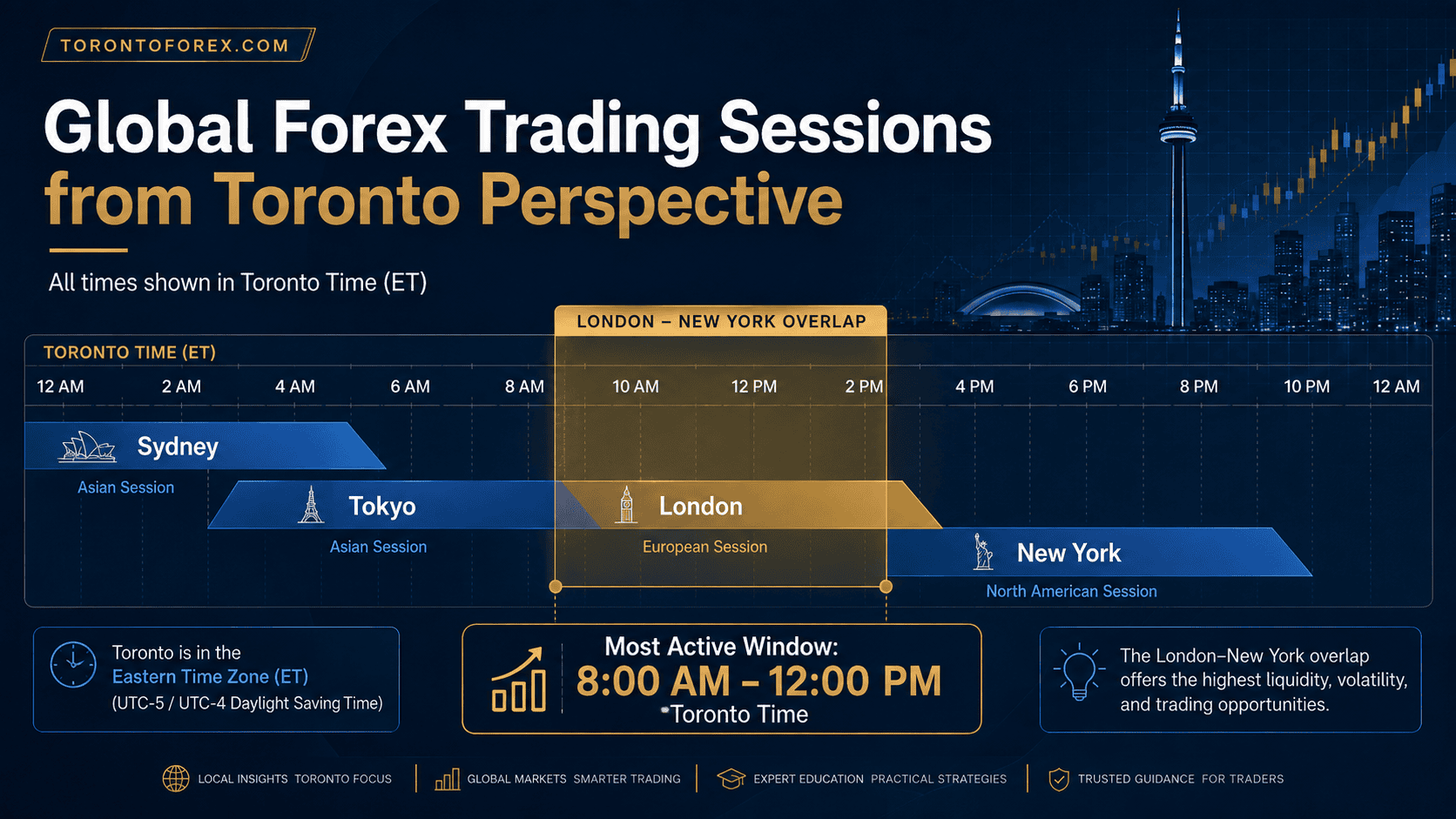
For many Toronto forex traders, the most important portion of the trading day occurs during the morning.
This captures much of the overlap between the London and New York financial sessions.
When two major financial centres are active simultaneously, forex markets can experience:
- greater liquidity;
- increased institutional participation;
- stronger momentum;
- higher trading activity;
- tighter spreads in highly liquid pairs;
- and important economic announcements.
However, increased market activity does not automatically mean better trading opportunities.
Some mornings develop strong directional moves. Others remain choppy or range-bound. On important economic-announcement days, markets may remain relatively quiet before suddenly becoming extremely volatile.
A disciplined trader learns to distinguish between market activity and a genuinely attractive trading opportunity.
For detailed session-specific information, continue to our Forex Market Hours hub.
Economic Releases Toronto Traders Should Watch
An economic calendar should be part of every serious forex trader’s daily preparation.
One particularly important time for traders in Toronto is:
8:30 a.m. Eastern Time.
Many important U.S. and Canadian economic reports are released around this time.
Examples can include:
- employment reports;
- Consumer Price Index data;
- Producer Price Index data;
- retail sales;
- GDP reports;
- trade statistics;
- and Canadian labour-market data.
Economic announcements can cause sudden increases in volatility as professional traders, institutions and automated trading systems rapidly reassess expectations.
Conditions around major announcements may include:
- wider spreads;
- slippage;
- rapid reversals;
- sudden momentum;
- and temporary liquidity changes.
Trading Principle
Knowing when not to trade is part of risk management. A major economic announcement can change the character of the market within seconds.
USD/CAD: The Most Relevant Major Pair for Canadian Traders
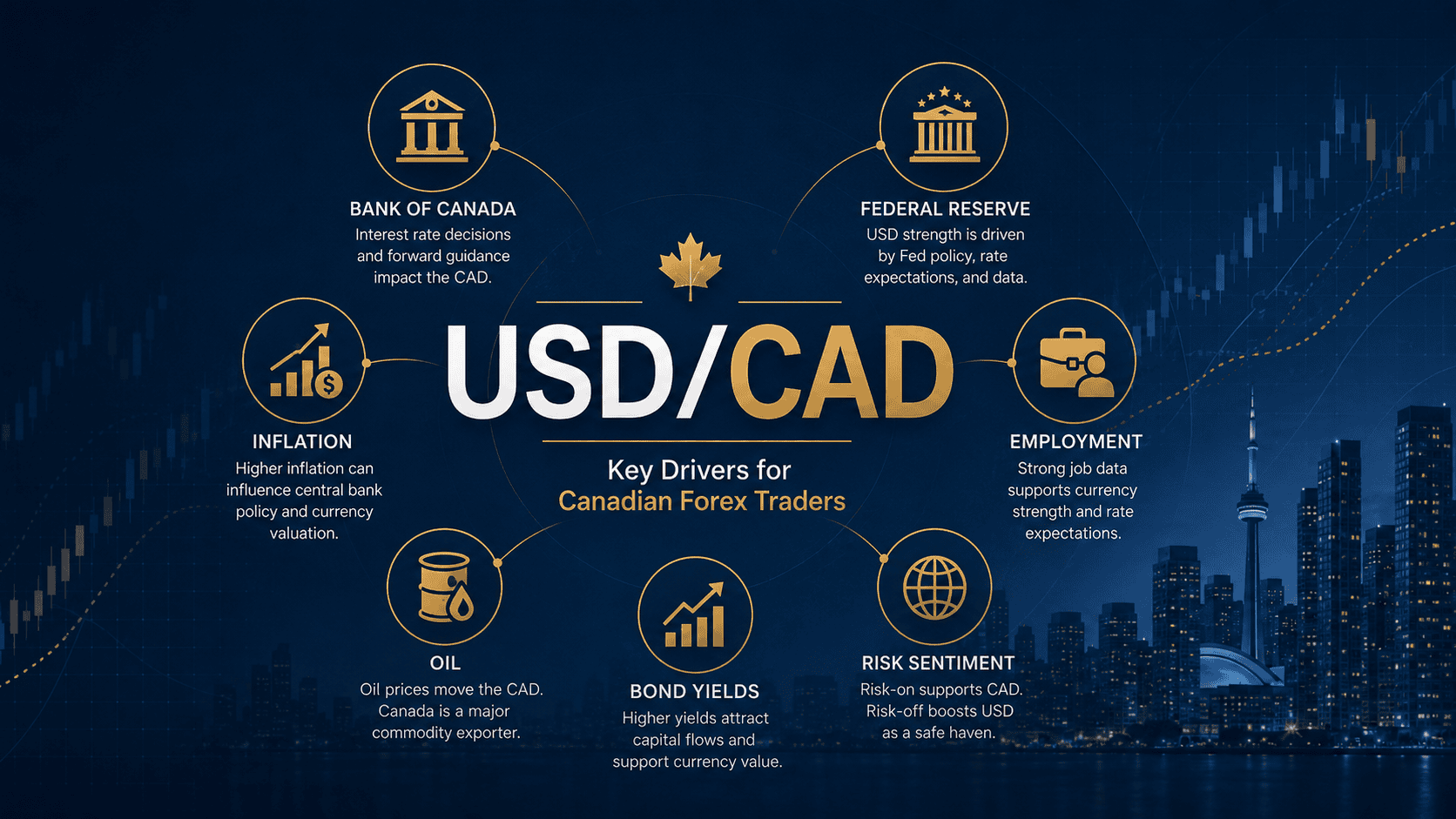
For Canadian traders, USD/CAD deserves particular attention.
USD/CAD represents the value of the U.S. dollar relative to the Canadian dollar.
When USD/CAD rises, the U.S. dollar is strengthening relative to the Canadian dollar.
When USD/CAD falls, the Canadian dollar is strengthening relative to the U.S. dollar.
Factors capable of influencing USD/CAD include:
- Bank of Canada monetary policy;
- Federal Reserve monetary policy;
- Canadian inflation;
- U.S. inflation;
- Canadian employment;
- U.S. employment;
- interest-rate expectations;
- oil and energy markets;
- economic growth expectations;
- and global risk sentiment.
Canada is an important commodity-producing economy, which means energy markets can sometimes influence expectations surrounding the Canadian dollar.
That does not mean crude oil and CAD must always move together.
Intermarket relationships can strengthen, weaken or disappear depending on economic conditions, monetary-policy expectations and market positioning.
Popular Currency Pairs for Toronto Traders
New traders sometimes believe they should monitor dozens of markets simultaneously.
That is usually unnecessary.
Many experienced traders become more effective by concentrating on a relatively small number of liquid instruments and learning how those markets behave under different conditions.
EUR/USD
EUR/USD is one of the world’s most heavily traded currency pairs and can become particularly active during the European session and London-New York overlap.
GBP/USD
GBP/USD frequently experiences substantial intraday movement. Greater volatility can create opportunity, but it can also demand wider stops or smaller position sizes.
USD/JPY
USD/JPY can react strongly to U.S. interest rates, Japanese monetary policy, government-bond yields and changes in global risk sentiment.
USD/CAD
USD/CAD is particularly relevant for Canadian traders because Canadian economic releases and Bank of Canada decisions directly influence one side of the pair.
AUD/USD
AUD/USD can respond to commodity markets, Chinese economic conditions, global growth expectations and broader investor risk appetite.
Is Forex Trading Legal in Canada?
Forex trading itself is not prohibited in Canada.
However, financial dealers and trading providers operate within regulatory frameworks, and Canadian traders should carefully investigate the entity through which they are opening an account.
Before depositing money, consider verifying:
- the legal entity providing the account;
- where that entity is regulated;
- whether it is permitted to serve Canadian residents;
- how customer funds are handled;
- withdrawal procedures;
- available leverage;
- product restrictions;
- and complaint and dispute procedures.
A professional-looking website should never be treated as proof that a financial provider is properly authorized.
Our Forex Trading in Canada section covers Canadian regulation, taxation and market-access issues in greater depth.
Important Considerations for Ontario Forex Traders
Ontario traders should be particularly careful when dealing with leveraged trading services.
A company might advertise that it accepts Canadian customers, but that statement alone does not answer several important questions.
Provider Due-Diligence Checklist
- Which legal company will administer my account?
- Where is that company located?
- What regulatory framework applies?
- Can that specific entity serve Ontario residents?
- Which financial products are actually available to Ontario clients?
This matters because availability can differ by jurisdiction, entity and financial product.
When evaluating providers, visit our Brokers & Platforms section.
Forex Brokers vs Prop Firms
A traditional forex broker and a retail proprietary trading firm are fundamentally different businesses.
Forex Broker
A broker provides customers with access to financial markets through a trading account.
Depending on the provider and account structure, customers generally deposit their own funds and trade using the broker’s platform or infrastructure.
Prop Firm
A modern retail prop firm usually provides traders with an evaluation or challenge governed by specific trading and drawdown rules.
Prop-firm rules can include:
- profit targets;
- daily drawdown limits;
- maximum drawdown;
- minimum trading days;
- consistency requirements;
- news-trading restrictions;
- position-size restrictions;
- and weekend holding rules.
After meeting a firm’s requirements, a trader may receive access to a funded or simulated-funded arrangement under that company’s rules.
TorontoForex.com will maintain dedicated prop-firm reviews and comparison pages so Canadian traders can evaluate these differences before purchasing an evaluation.
Understanding Forex Leverage
Leverage allows traders to control positions larger than the capital required as margin.
This magnifies potential gains.
It also magnifies losses.
The second point is much more important than many beginners initially realize.
A heavily leveraged position can create a substantial account drawdown from a relatively small market movement.
Position Sizing and Forex Risk Management
Position sizing is one of the foundations of professional risk management.
Imagine two traders entering exactly the same EUR/USD trade.
They use the same:
- entry;
- stop loss;
- profit target.
Trader A risks 1% of the account.
Trader B risks 10%.
The technical trade may be identical.
The financial exposure is completely different.
This is why risk should be determined before the trade is entered.
Continue to our Forex Risk Management section for dedicated guides covering position sizing, drawdown control, trading psychology and capital protection.
A Basic Pre-Trade Risk Framework
| Step | Question |
|---|---|
| 1. Entry | Where will the position be opened? |
| 2. Invalidation | At what point is the trade idea wrong? |
| 3. Stop Loss | Where will the position be closed if the idea fails? |
| 4. Position Size | How much capital is actually at risk? |
| 5. Target | Where will profits reasonably be taken? |
If those questions cannot be answered before entering, the trade probably has not been fully planned.
Developing this kind of structured decision-making is also an important part of live trading education in Toronto, where students can work directly on planning, execution and risk rather than simply memorizing trade setups.
Technical Analysis for Forex Traders
Technical analysis studies market behaviour using price, structure, volatility and other market information.
Common technical concepts include:
- support and resistance;
- trends;
- swing highs;
- swing lows;
- market structure;
- moving averages;
- momentum;
- candlestick behaviour;
- breakouts;
- pullbacks;
- and volatility.
A common beginner mistake is placing too many indicators on the same chart.
Five indicators do not necessarily provide five independent confirmations.
Several indicators may simply be measuring similar information using different mathematical calculations.
A cleaner trading process can be easier to understand, test and execute consistently.
Explore our Forex Education hub for more technical-analysis lessons.
Understanding Forex Market Structure
Market structure describes how price forms highs and lows.
Bullish Structure
In bullish conditions, traders may observe a sequence of higher highs and higher lows.
Bearish Structure
In bearish conditions, traders may observe a sequence of lower highs and lower lows.
When those relationships begin changing, the character of the market may also be changing.
However, traders should not automatically assume that every broken high or low creates an immediate trading opportunity.
Context still matters.
Consider:
- larger market direction;
- time of day;
- volatility;
- economic events;
- liquidity;
- entry location;
- and risk-to-reward.
A trader can correctly identify market direction and still execute a poor trade because the timing or entry location was wrong.
This distinction becomes especially important in fast-moving markets where a correct directional forecast does not necessarily translate into a good entry.
Why Fundamental Analysis Matters in Forex
Forex is heavily influenced by macroeconomics.
Currencies represent economies.
Market participants continually reassess expectations concerning:
- interest rates;
- inflation;
- employment;
- economic growth;
- central-bank policy;
- government policy;
- international capital flows;
- and geopolitical risk.
A forex trader does not need to become a professional economist.
But completely ignoring macroeconomic conditions means ignoring one of the primary forces capable of influencing currency valuation.
The objective is not necessarily to predict every economic report.
It is to understand the broader environment in which the technical setup is developing.
Bank of Canada and the Canadian Dollar
The Bank of Canada plays a central role in Canadian monetary policy.
Forex traders monitor Bank of Canada decisions because changes in monetary-policy expectations can affect Canadian interest rates, government-bond yields and the value of the Canadian dollar.
Markets may respond not only to the interest-rate decision itself but also to:
- forward guidance;
- inflation expectations;
- economic-growth forecasts;
- employment conditions;
- and language concerning future policy.
Why Toronto Traders Need to Follow the Federal Reserve
The U.S. dollar appears in many of the world’s most actively traded currency pairs.
Federal Reserve policy can therefore influence:
- EUR/USD;
- GBP/USD;
- USD/CAD;
- USD/JPY;
- AUD/USD;
- gold;
- equity indices;
- and government-bond yields.
Even traders concentrating mainly on USD/CAD should understand the basic direction of U.S. monetary policy.
There are always two currencies in a forex pair.
Studying Canada while completely ignoring the United States provides only half of the picture.
How Is Forex Trading Taxed in Canada?
Canadian taxation of trading activity requires careful attention.
The tax treatment can depend on the nature and circumstances of the trading activity, which means active traders should not automatically assume that every trading profit will receive identical tax treatment.
Anyone generating meaningful income from forex, derivatives or other active trading should consider consulting a Canadian accountant or tax professional familiar with trading activity.
Important
TorontoForex.com provides general educational information only. Nothing on this website should be considered individualized tax, accounting, investment or legal advice.
Keep Accurate Trading Records
Regardless of eventual tax treatment, organized records are important.
Consider maintaining records of:
- deposits;
- withdrawals;
- executed trades;
- commissions;
- platform fees;
- currency-conversion rates;
- monthly statements;
- and annual profit-and-loss reports.
Do not wait until tax season to reconstruct an entire year of trading activity.
Can You Make a Living Trading Forex?
It is possible for individuals to generate income from trading.
That does not mean doing so is easy, common or guaranteed.
Trading performance can vary significantly.
A trader may experience:
- losing days;
- losing weeks;
- drawdowns;
- changing market conditions;
- execution mistakes;
- and psychological pressure.
Professional consistency is considerably more difficult than identifying a historical setup that appears profitable on a chart.
Anyone treating forex trading seriously should prioritize capital preservation, discipline and process over spectacular short-term returns.
Common Forex Trading Mistakes
Trading Too Frequently
More trades do not automatically create more profit. They can simply create more transaction costs and more opportunities to make mistakes.
Risking Too Much
One oversized position can erase weeks of otherwise disciplined trading. Position size should reflect predefined risk rather than confidence or emotion.
Moving Stop Losses
A controlled loss can quickly become an uncontrolled one when a trader moves a stop because they hope the market will reverse.
Revenge Trading
Trying to immediately recover a previous loss can lead to emotional entries, weak setups and excessive exposure.
Trading News Without a Plan
Economic announcements can create rapid price movement, spread expansion and slippage. A trader should know whether the strategy permits trading around those events.
Strategy Hopping
Constantly abandoning one method after a few losing trades can prevent a trader from collecting enough evidence to properly evaluate any one approach.
How to Build a Forex Trading Plan
A trading plan defines the circumstances under which a trader is willing to risk capital.
A useful plan should document:
- markets traded;
- trading hours;
- approved setups;
- entry criteria;
- invalidation criteria;
- stop placement;
- profit-taking rules;
- maximum risk per trade;
- maximum daily loss;
- economic-news rules;
- and review procedures.
The objective is to reduce the number of important decisions being made emotionally while money is already at risk.
A good trading plan should eventually become personal to the trader rather than being a generic checklist copied from somebody else.
Traders who want direct assistance developing that type of structured process can explore the Toronto trading mentorship programs at Academy of Financial Markets.
Why Every Forex Trader Should Keep a Journal
A trading journal can reveal patterns that are difficult to recognize while trades are occurring in real time.
A useful trading journal records considerably more than profit and loss.
Consider documenting:
- date;
- currency pair;
- entry price;
- stop loss;
- profit target;
- position size;
- percentage risk;
- setup;
- reasoning;
- market conditions;
- economic news;
- result;
- execution mistakes;
- and psychological state.
After 50 or 100 properly documented trades, useful patterns may begin to emerge.
You might discover that:
- certain setups perform better than others;
- particular trading hours produce more mistakes;
- emotional trades occur after consecutive losses;
- some currency pairs do not suit your strategy;
- or certain market environments consistently create problems.
Without records, these patterns are much harder to validate objectively.
Should Beginners Practice With a Demo Account?
New traders should consider practicing in a simulated environment before risking meaningful real capital.
Demo trading can help develop:
- platform familiarity;
- order execution;
- position sizing;
- stop placement;
- trade management;
- and routine.
However, simulated trading cannot perfectly reproduce the psychological pressure associated with trading real money.
The goal should not be generating enormous simulated profits.
The objective should be learning how to execute a repeatable process correctly.
MT4, MT5 and Other Forex Trading Platforms
Toronto traders may encounter different platforms depending on their broker, trading provider or prop firm.
Popular platforms include:
- MetaTrader 4;
- MetaTrader 5;
- cTrader;
- TradingView integrations;
- and proprietary trading platforms.
MetaTrader 5 is widely used because it can support:
- forex;
- commodities;
- indices;
- automated trading;
- custom indicators;
- and strategy testing.
Platform availability can vary by provider and jurisdiction.
Ontario residents should verify that the desired platform and financial products are available before purchasing an account or trading evaluation.
See our Canadian Forex Brokers & Platforms section for ongoing comparisons.
Forex Trading From Home in Toronto
Modern forex trading does not require a professional trading floor.
Practical Home Trading Setup
- A reliable computer
- A stable internet connection
- Trading software
- An economic calendar
- Charting software
- A trading journal
- Backup internet access
Multiple screens can be convenient, but they are not what creates a successful trader.
The quality of the decision-making process matters considerably more than the amount of hardware on the desk.
Trading Forex While Working a Full-Time Job
Many Toronto traders begin learning forex while maintaining full-time employment.
That can actually have advantages.
A trader with stable employment income may feel less pressure to force trades simply because they need to generate immediate income from the market.
Depending on their schedule, traders may focus on:
- Toronto morning sessions;
- higher-timeframe setups;
- swing trading;
- pending orders;
- and evening analysis for the following day.
A trading strategy should fit the trader’s actual lifestyle.
A strategy requiring constant screen monitoring will probably not suit somebody working another job throughout the trading day.
How Much Money Do You Need to Start Forex Trading?
There is no universal answer.
The appropriate amount depends on:
- provider requirements;
- position sizing;
- trading strategy;
- risk tolerance;
- and personal financial circumstances.
A small account should not be expected to immediately replace employment income.
Attempting to turn very limited capital into substantial income generally requires taking excessive risk.
Smaller accounts may instead be useful for developing execution, discipline and risk-management habits.
Should Beginners Use Prop Firms?
Prop firms can provide an alternative path to accessing larger notional trading capital.
However, prop-firm trading introduces another major variable:
The firm’s rules.
A trading strategy may be profitable over time and still fail a prop evaluation because the trader violates:
- daily drawdown;
- maximum drawdown;
- consistency requirements;
- news restrictions;
- position-size limitations;
- or holding rules.
Before purchasing any prop-firm evaluation, read the complete rules rather than relying exclusively on advertisements or social-media claims.
TorontoForex.com will publish detailed prop-firm reviews and comparison pages to help Canadian traders understand these differences before purchasing evaluations.
How to Learn Forex Trading in Toronto
There are several ways to learn forex trading in Toronto, and the right approach depends on experience, budget, learning style and how much structure a trader requires.
Self-Study
Books, educational websites, videos, chart observation and independent practice can provide a useful foundation. Self-study has a relatively low financial barrier but requires discipline and the ability to separate legitimate information from marketing hype.
Online Trading Courses
Online courses can organize information into a structured learning sequence. Quality varies substantially, so students should investigate who created the material, how current it is and whether meaningful support is available.
Group Trading Classes
Group instruction can provide structure and interaction, although the instructor cannot always focus extensively on each student’s individual weaknesses and trading decisions.
Private Trading Mentorship
Private mentorship allows instruction to focus more directly on an individual trader’s knowledge gaps, decision-making, execution, risk management and objectives.
Toronto traders interested in direct instruction can learn more about private forex and financial-markets training in Toronto through Academy of Financial Markets.
The program is built around live instruction and direct interaction rather than relying exclusively on a library of prerecorded material.
If you would rather discuss your experience and objectives before deciding whether mentorship makes sense, you can book a free student consultation.
Want More Structure Than Self-Study Alone?
Academy of Financial Markets offers live, one-on-one trading mentorship designed around your experience, goals and trading process. Work directly with an instructor to improve market analysis, risk management, trade planning and execution through personalized feedback.

LIVE TRADING EDUCATION · TORONTO
Questions to Ask Before Paying for Forex Education
Education Provider Checklist
- Is the instruction live or prerecorded?
- Is the program private or group-based?
- Who will actually teach me?
- What experience does the instructor have?
- Will my own trades be reviewed?
- Does the program emphasize risk management?
- Are unrealistic returns being promised?
- Will the program help me eventually make decisions independently?
Any organization promising guaranteed trading profits should raise immediate concerns.
Financial markets do not provide guaranteed outcomes.
Students who prefer speaking with someone before enrolling can use the Academy’s free trading education consultation.
Toronto Forex Trading Checklist
Before Placing a Trade
- What is the broader market direction?
- What fundamental factors are affecting this currency?
- Is a major economic announcement approaching?
- Where is my entry?
- Where is my invalidation?
- Where is my stop loss?
- How much of my capital is at risk?
- Does the expected reward justify that risk?
- Am I entering because a valid setup exists?
- Or am I simply looking for action?
If these questions cannot be answered clearly, waiting may be the better trading decision.
Final Thoughts on Toronto Forex Trading
Toronto is an excellent location geographically for participating in the global foreign exchange market.
The city operates directly within the North American trading day, provides convenient access to Canadian and U.S. economic information and allows local traders to participate during one of the most active periods of the global currency market.
But location alone does not create profitable trading.
Long-term development depends on:
- education;
- risk management;
- planning;
- practice;
- record keeping;
- discipline;
- patience;
- and adaptability.
The objective of TorontoForex.com is to build one of Canada’s most useful online resources for traders who want to better understand the foreign exchange market without relying on hype, unrealistic promises or shortcuts.
Continue learning through our:
- Toronto Forex Market Hours
- Forex Trading in Canada
- Forex Education
- Brokers & Platforms
- Forex Risk Management
- Latest Forex Insights
If self-study is no longer providing enough structure, you can also learn more about one-on-one trading education at Academy of Financial Markets.
Those who want to understand the program before making a commitment can schedule a free consultation with the Academy.